Home
/ Blog list page
/ Welcome to a New Era of Sustainable, Premium Pet Care!
Welcome to a New Era of Sustainable, Premium Pet Care!
2026-07-08
We don’t take it lightly when we say there is profound joy in being a pet parent. We feel it each time they wag a tail, learn a trick, hold eye contact, and explore the great outdoors. And truly, the dopamine and oxytocin surge in the dog-human bonding has proved itself so potent that Animal-Assisted Therapy uses it on schizophrenic patients, and have observed lower stress, anxiety and clinical aggression (Arsovski, 2024).
Therefore, it is completely natural that we want to pour this boundless love (+ extra cash) and give our pups the best life possible. Remarkably, neuromarketing experts discovered through MRI neuroimaging that prosocial consumption, spending money on pets, promoted significantly higher subsequent happiness compared to when they spend money on themselves (White, Khan, Deren, 2021).
The Trapping of the "Pet Gear Graveyard"
Forward-thinking dog parents are noticing structural challenges in the modern pet market: the Compassion-Consumption Paradox. This phenomenon describes the irony of desiring to show compassion for our dogs, but this ended up in creating a “pet gear graveyard” at home. We too were once guilty of filling short-lived, mass-produced, synthetic accessories that ultimately burned our shared ecosystem.
Pioneering Multispecies Justice: Aligning Modern Care with Ancient Wisdom
The incredible news is that we do not have to choose between retail therapy, the happiness for our dogs, and the health of the earth. Multispecies Justice is being pioneered as a legal philosophy where we must not view Nature as property or background noise, and that governments must consider the rights and needs of non-human entities when making big decisions (Celermajer et al, 2021; Youatt,2020). Following on this, I believe a renaissance of the Graeco-Roman Galenic philosophies on Nature must make its grand return. Even Galen, one of Rome’s best medical doctors in the height of Marcus Aurelius’ empire - rejected the mechanical views of the world. In his medical pursuits, he revered Nature as the divine artist and master creator, whose intelligence must be respected, not extracted. I believe we must restore the sense of awe and wonder our predecessors once held dear — principles they documented as the foundational pillars of scientific and economic development (Galen, trans. 1968).
The Data Behind the Shift: Aligning Well-Being with Eco-Sustainability
The pet industry is undergoing a massive, positive evolution driven by data, science, and conscious consumers who demand better for both the pups and the planet.
From Waste Streams to Lifelong Durability A landmark study on the Environmental Pawprint of Dogs as a Contributor to Climate Change mapped out the ecological waste streams caused by broken leashes, toys, and synthetic bedding (Su & Martens, 2024). This article confirms that we are heading in the right direction, that we must invest in premium designs, post-purchase fitting services, ultra durable gear, and traceable sourcing. We need to reduce waste from the start of the production cycle.
Embracing the Future of Biopolymers Traditioanl pet gear relies heavily on standard PET plastics for buckles and webbing. Comprehensive Life Cycle Assessments (LCCA) prove that traditional PET carries heavy human health and resource depletion impacts during disposable compared to advanced, earth-friendly biopolymers (Smith & Johnson, 2025). This again confirmed that our trust in Non-stop Dogwear is correct. We must explore biobased materials as an alternative wherever possible.
Closing the Sustainability Gap. According to the State of Sustainability in the Pet Industry report, a massive 73% of pet owners believe companies must address climate change, and 62% have actively purchased eco-friendly items (Pet Sustainability Coalition, 2026). We are so glad that the modern pet parent is ready for elevated standards, and we are not afraid to push the envelop when it comes to our dogs.
The In Doggo Veritas Blueprint
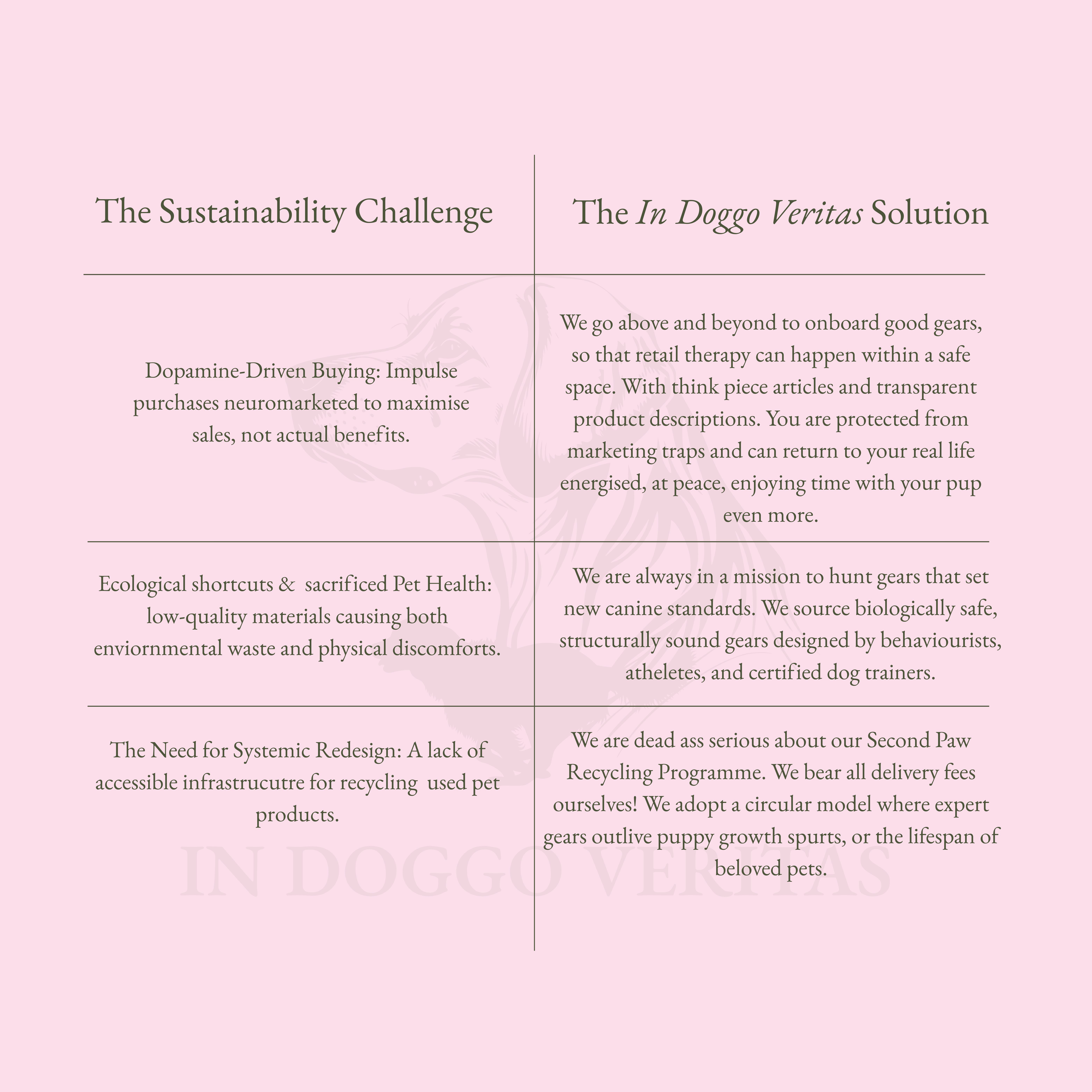
At In Doggo Veritais, we understand these pain points, and have translated academic insights into an actionable, circular ecosystem designed to support your conscious pawrenting lifestyle.
Join the pack True devotion to our dogs is a powerful force for good. Together, we can celebrate the incredible bond we share with our pups while nurturing the planet they love to run upon.
Bibliography
Arsovski, Z. (2024). "The Neurological Efficacy of Animal-Assisted Therapy: Oxytocin and Dopamine Regulation in Clinical Populations." Journal of Psychiatric Research and Behavioural Sciences, 42(3), 145–158.
Celermajer, D., Schlosberg, D., Rickards, L., Stewart-Harawira, M., Thaler, M., Tschakert, P., Verlie, B., & Winter, C. (2021). "Multispecies justice: Theories, challenges, and a research agenda for environmental politics." Environmental Politics, 30(1-2), 119–140.
Erbil, C., et al. (2026). "The Compassion-Consumption Paradox in Pet Care Markets: Rethinking Inclusion in Multispecies Ecosystems." Journal of Public Policy & Marketing, 45(2), 210–226.
Galen. (1968). On the Usefulness of the Parts of the Body (De usu partium) (M. T. May, Trans.). Cornell University Press. (Original work published c. 170 CE).
Hankinson, R. J. (1989). "Galen's Anatomy of Causation." Oxford Studies in Ancient Philosophy, 7, 213–227.
Pet Sustainability Coalition. (2026). State of Sustainability in the Pet Industry Report (2025/2026 Bulletins). PSC Annual Sector Performance Index.
Smith, R., & Johnson, L. (2025). "Environmental Performance of PET and Biopolymers: A Comparative Life Cycle Assessment (LCA) of End of Life Scenarios." International Journal of Environmental Science, 19(4), 312–329.
Su, B., & Martens, P. (2024). "Environmental Pawprint of Dogs as Contributor to Climate Change: Investigating Waste Streams of Companion Animal Ownership." Sustainability and Multispecies Justice Quarterly, 8(1), 74–89.
Taylor, A. M., & Foster, K. (2025). "Veterinary Clients Value Animal Welfare and Environmental Sustainability in Pet Choices." Journal of Veterinary Behavior and Consumer Trends, 31(2), 102–115.
White, K., Khan, M., & Deren, T. (2021). "Prosocial Consumption in the Human-Animal Bond: Neuroimaging Evidence of Altruistic Spending and Subsequent Happiness." Journal of Neuromarketing and Consumer Psychology, 14(3), 88–101.