Home
/ Blog list page
/ Why We Believe Each Pup Deserves a Canuzzo Harness
Why We Believe Each Pup Deserves a Canuzzo Harness
2026-10-12
For urban-dwelling dogs, daily walks represent far more than a simple bathroom routine—they are vital opportunities for sensory enrichment, physical exertion, and cognitive engagement. We recommend at least 1 to 1.5 hours of daily walks for city pups to maintain their emotional and physical well-being. However, because our dogs cannot verbally express when their gear feels heavy, restrictive, or uncomfortable, selecting walking equipment is a critical welfare choice. Biomechanical assessments confirm that equipment design measurably alters canine stride, joint angles, and forelimb kinematics (Lafuente et al., 2019; Williams et al., 2023). The Canuzzo Harness was engineered to eliminate these subtle mechanical obstacles, restoring true physiological freedom to every single step.
1. Ultra-Lightweight Engineering: Eliminating Mass-Induced Gait Compensation Traditional harnesses frequently incorporate heavy padding, dense chest plates, and metal hardware under the premise of comfort or durability. However, extra mass alters a dog’s centre of gravity and increases the rotational inertia of the torso during dynamic movement.
Minimising Mechanical Burden: Utilising lightweight, high-tensile webbing reduces the physical load imposed on the dog’s musculoskeletal system during locomotion.
Preserving Natural Kinematics: Minimising gear mass prevents compensatory stride shortening, shoulder hiking, and altered forelimb kinematics—adaptations dogs make when continually compensating for restrictive or heavy equipment (Weissenbacher et al., 2022).
2. True Y-Shaped Geometry: Uninhibited Shoulder Kinematics Horizontal chest straps cross directly over the shoulder joint, restricting full limb extension and altering forelimb mechanics during both the walk and trot (Lafuente et al., 2019). A properly designed Y-shaped harness respects canine functional anatomy.
Understanding Canine Synsarcosis: Unlike humans, dogs lack a collarbone (clavicle). Their forelimbs attach to the trunk entirely via a complex muscular and tendinous assembly known as a synsarcosis.
Unrestricted Joint Motion: Horizontal straps cross the glenohumeral (shoulder) joint, impeding shoulder extension and scapular slide during limb protraction. The Canuzzo Harness's Y-shaped configuration keeps straps clear of both the scapula and the shoulder joint, helping maintain natural stride length and joint dynamics (Lafuente et al., 2019; Williams et al., 2023).
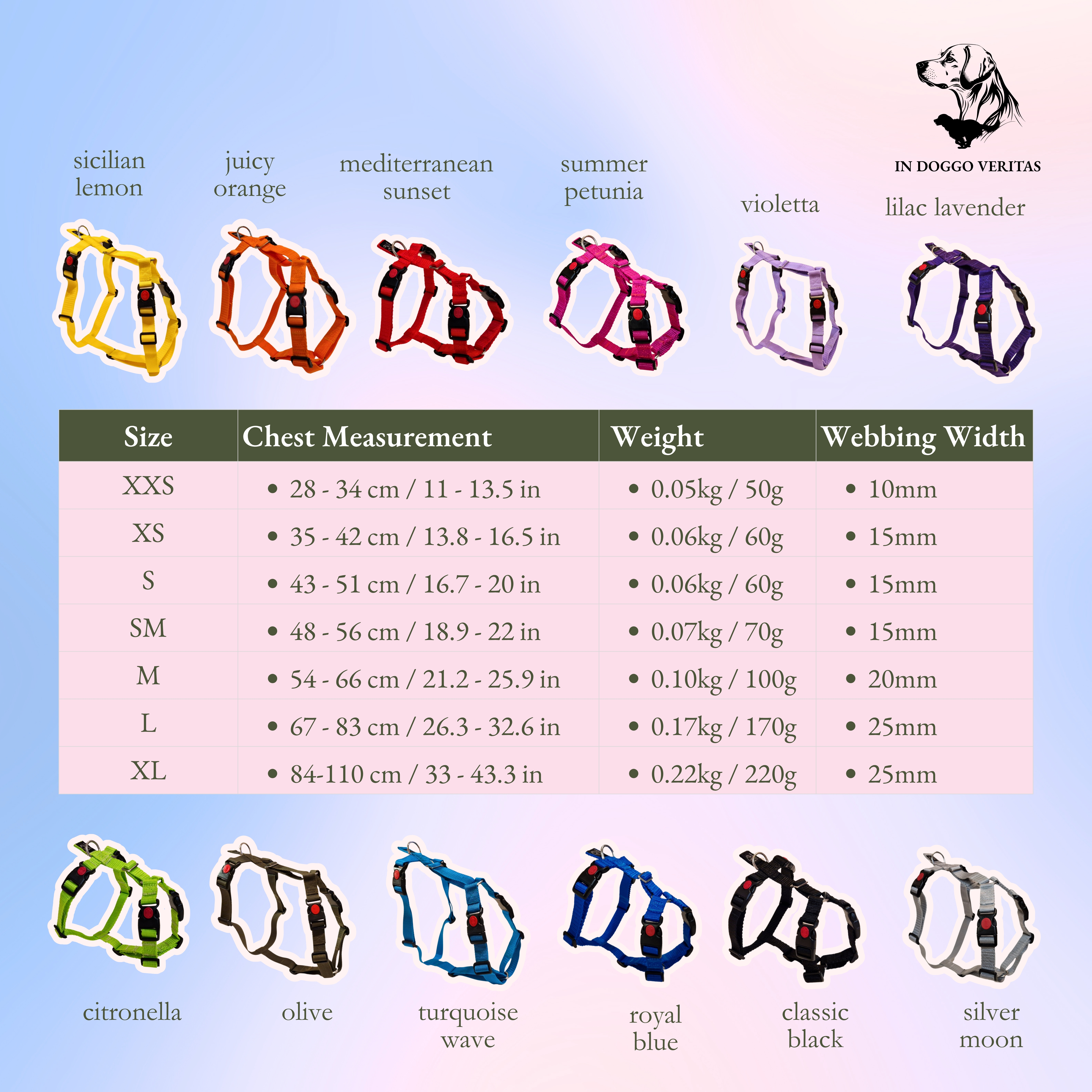
3. Six Points of Precision Adjustability: Optimal Clearance of Sensitive Soft Tissue & Joints Canine body proportions vary significantly across breeds and individual conformations. Standard harnesses with limited adjustment points often force compromises that lead to tissue strain or focal pressure. The Canuzzo Harness features 6 distinct points of adjustability, enabling a customised fit that respects sensitive anatomical structures.
Anatomical Clearance: Independent adjustments along both the neck and torso allow handlers to position the girth strap safely behind the glenohumeral joint and clear of the axillary area (armpit). This design prevents soft-tissue chafing, avoids pressure on floating ribs or sensitive abdominal tissue, and eliminates elbow interference during full trot and gallop strides (Shih et al., 2021).
Our Fitting Tip: Position the side straps so they rest gently over the ribcage, ensuring ample clearance behind the axilla so the elbow can swing backward without obstruction during locomotion.
A Welfare-First Approach to Canine Gear Equipping your dog for city life should not come at the expense of their long-term orthopaedic health or daily comfort. Through lightweight materials, anatomical Y-geometry, and precise multi-point adjustability, the Canuzzo Harness supports canine biomechanics—ensuring every walk remains comfortable, unrestricted, and enjoyable.
Bibliography:
Lafuente, M. P., Provis, L., & Schmalz, E. A. (2019). Effects of restrictive and non-restrictive harnesses on shoulder extension in dogs at walk and trot. Veterinary Record, 184(2), 64. https://doi.org/10.1136/vr.104946
Pálya, Z., Rácz, K., Nagymáté, G., & Kiss, R. M. (2022). Development of a detailed canine gait analysis method for evaluating harnesses: A pilot study. PLOS ONE, 17(3), e0264299. https://doi.org/10.1371/journal.pone.0264299
Shih, H.-Y., Phillips, C. J. C., Mills, D. S., et al. (2021). Dog Pulling on the Leash: Effects of Restraint by a Neck Collar vs. a Chest Harness. Frontiers in Veterinary Science, 8, 735680. https://doi.org/10.3390/fvets.2021.735680
Weissenbacher, A., Tichy, A., Weissenbacher, K., & Bockstahler, B. (2022). Influence of Two Types of Guide Harnesses on Ground Reaction Forces and Step Length of Guide Dogs for the Blind. Animals, 12(18), 2453. https://doi.org/10.3390/ani12182453
Williams, E., Hunton, V., Boyd, J., & Carter, A. (2023). Effect of harness design on the biomechanics of domestic dogs (Canis lupus familiaris). Journal of Applied Animal Welfare Science, 28(2), 301–317. https://doi.org/10.1080/10888705.2023.2259796